
AI is everywhere in the conversation around print. From automated workflows and predictive systems to quality control and generative tools, the technology promises to make production faster, smarter, and more efficient.
But there’s a difference between technology that’s genuinely useful and technology that’s simply new.
At Dominion, we’ve always believed in investing in the right technology – not every technology. After more than 40 years in large-format print, we’ve seen plenty of innovation reshape the industry, and we’ve adopted it when it has delivered a meaningful improvement for our clients, our people, or our processes.
So, where does AI fit into that picture?
AI isn’t automatically innovation
We recently spent time at FESPA, one of the industry’s major showcases for print technology. AI was understandably prominent, but our biggest takeaway wasn’t that AI is transforming print overnight. It was that much of the technology being presented is still developing.
We saw, for example, an AI system intended to carry out quality checks at the back of a press. When we asked to see it demonstrated in practice, it wasn’t possible to properly show the system working.
That experience raised an important question: when the industry talks about AI, how much of what we’re actually seeing is commercially proven technology, and how much is a glimpse of what might be possible in the future?
It’s an important distinction because not everything described as AI is necessarily AI. Some applications are better described as workflow automation, management information systems, or robotics. Those technologies can be extremely valuable – but giving an existing automated process an AI label doesn’t make it more innovative.
For print buyers, that distinction matters. If technology is going to change how a project is produced, it should be clear what it actually does and what benefit it delivers.
What makes technology worth adopting?
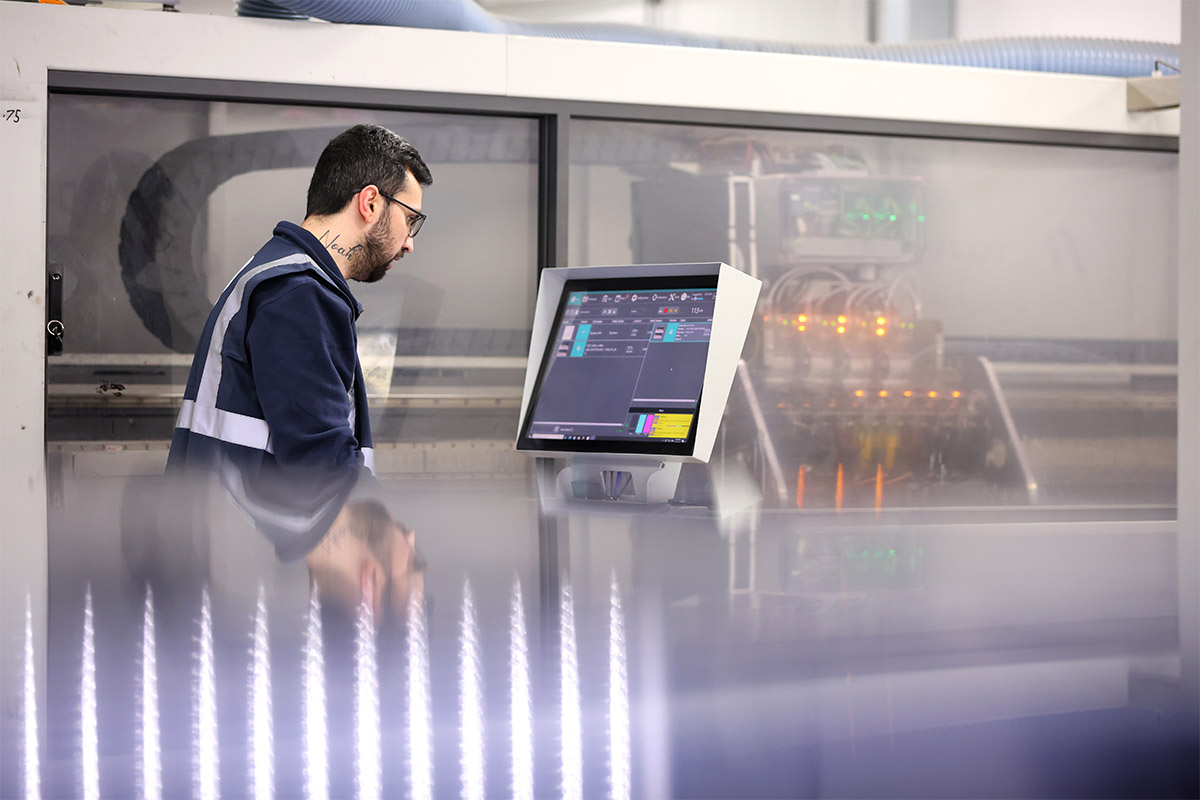
Dominion has never been reluctant to embrace new technology. In fact, our history is one of continual investment and adaptation – from our early adoption of digital printing technology to the state-of-the-art production equipment we use today. Our approach has always been to combine technology with the expertise of the people operating it.
That remains our position with AI. The question isn’t whether AI belongs in print. It’s whether a particular application of AI makes the print process better.
Could it improve machine efficiency? Could it identify a quality issue earlier and prevent a reprint? Could it reduce material waste? Could it improve consistency across a high-volume campaign? Could it help our team manage complex production more effectively?
If the answer is yes – and the technology is reliable enough to prove it – then it becomes worth taking seriously.
That is consistent with the wider approach we take to production. Our large-format print process is built around investing in the right technology while retaining the expertise of skilled operators. The objective is not simply to have impressive machinery. It is to use the right machinery, in the right way, to deliver the right result.
The sustainability question
There is another reason to take a measured approach to AI: sustainability.
Print is rightly subject to scrutiny over its environmental impact. As an industry, we’ve spent years looking at materials, waste, energy consumption, recycling, and production efficiency. At Dominion, sustainability is built into decisions across our operation – from the materials and inks we use to how we manage waste and energy.
Our sustainability programme includes LED lighting across our 60,000 sq ft facility, on-site solar generation, water-based pigments, recycled and recyclable fabrics, and processes designed to keep both PVC and non-PVC products out of landfill. We’ve also moved to a 95% paperless production workflow. In 2024 alone, we produced approximately 621,520 metres of print, so reducing the impact of that production matters.
That’s why the environmental cost of digital technology deserves consideration too.
The International Energy Agency projects that global data centre electricity consumption will more than double by 2030, reaching around 945 TWh – slightly more than Japan’s current annual electricity consumption. AI is expected to be the most significant driver of that increase.
That doesn’t mean AI is inherently unsustainable. The same IEA analysis points to the potential for AI to improve efficiency and reduce emissions in other parts of the economy. It does, however, mean that “AI” shouldn’t automatically be treated as synonymous with progress or efficiency. Its benefits and costs both need to be considered.
For an industry that rightly asks difficult questions about the environmental impact of physical production, it would be inconsistent to ignore the environmental impact of the technology being used to support it.

Technology should enhance expertise
There’s a human question here, too. Large-format print is a highly technical process. A successful project depends on far more than a file being sent to a printer. It involves material selection, colour management, production planning, finishing, quality control, logistics, and installation – often under significant time pressure.
Technology can make those processes more efficient, but it doesn’t eliminate the need for expertise.
At Dominion, we combine hands-on craft with cutting-edge technology, with experienced specialists working alongside our production equipment to deliver complex projects accurately and efficiently.
That’s how we see AI fitting into the industry. The most useful applications should give skilled people better information, remove repetitive tasks, reduce avoidable errors, and help them make better decisions. The objective should be to strengthen expertise, not simply remove it.
What should print buyers be asking about AI?
For businesses and agencies considering AI-enabled print technology, there are a few straightforward questions worth asking.
First, what is actually “AI” about the technology? Understanding whether a system uses machine learning, generative AI, automation, or another established technology makes it easier to judge what it can realistically do.
Second, is it proven? There is a considerable difference between a technology being demonstrated at a trade show and being reliable enough to use every day in a production environment.
Third, what measurable improvement does it deliver? Faster production, fewer errors, better quality, lower waste, or greater consistency are meaningful outcomes. “AI-powered” on its own is not.
And finally, does it improve the overall process? A technology that saves time but creates additional waste, compromises quality, or requires more intervention elsewhere in the workflow may not be an improvement at all.
Those questions are not intended to slow innovation down. They’re intended to make sure innovation is worthwhile.
A measured approach to the future
AI will continue to develop, and we expect it to have an increasingly important role in print. There’ll be applications that genuinely improve efficiency, quality control, production planning, and other parts of the process. As those technologies mature, we’ll continue to assess them.
But we don’t believe in adopting technology simply to keep up with a trend, satisfy a procurement checklist, or have “AI” attached to our name.
Dominion has spent more than 40 years embracing technological change. Our history shows that we’re not cautious about innovation – we’re selective about it. We invest when there’s a clear reason to do so, and when the result is better for our clients, our people, and the way we operate.
For us, that is what the future of print should look like: not technology for technology’s sake, but proven innovation that makes a real difference.
SHARE